Kids' room mural ideas: choosing one they won't outgrow
Every children's room starts with the same quiet worry, and it is rarely about wallpaper. It is: how long will this last? A wall decorated for a three-year-old can feel babyish to a seven-year-old, and nobody wants to redo the same room twice in four years.
Murals age better than most people expect. The trick is choosing for the room rather than for the birthday. Here is how we would go about it.
Read the light before you read the pattern
Walk into the room at about four in the afternoon and look at which wall the light lands on. That wall will wash out a pale design and flatten it. A deeper, warmer scene holds its colour there.
The wall opposite gets the shade. That is where pale grounds stay crisp and where fine line work actually reads, instead of disappearing into glare.
Most children's rooms in a condo have exactly one wall worth papering, and the light usually decides which.
Busy is fine. Busy opposite the bed is not.
There is a difference between a wall a child can explore and a wall a child has to fall asleep facing. Both are good. They are not the same wall.
Put the detailed scene behind the bed, where they see it during the day and not at night. Keep the wall they look at from the pillow calmer — a single tone, a gentle repeat, something with fewer eyes in it.
This one decision solves more bedtime complaints than any colour choice.

A scene, or a pattern that tiles
Some designs are one continuous picture, sized to your wall. Others are a repeat — the pattern starts again at a fixed interval, so it tiles neatly across any width you give it.
A scene makes a feature wall. A repeat can cover a whole room without ever looking like it ran out. If you want all four walls done, or an awkward wall with a door and a window in it, a repeat is almost always the easier answer.
The material matters more in a child's room
This is the part worth slowing down for. Our fabric-backed wallcovering is soft to the touch, hides the small imperfections every plastered wall has, and is made without phthalates, heavy metals, formaldehyde or phenol, with low-emission certification. For a nursery, that is the one we would choose.
If the room is rented, the peel-and-stick options come off again without taking the paint with them. Every finish is priced per square metre and you can compare them side by side on our materials page.
Eight designs, and the rooms they suit
These are from Kikki Belle, a range drawn specifically for children — detailed enough to keep looking at, calm enough to sleep near.
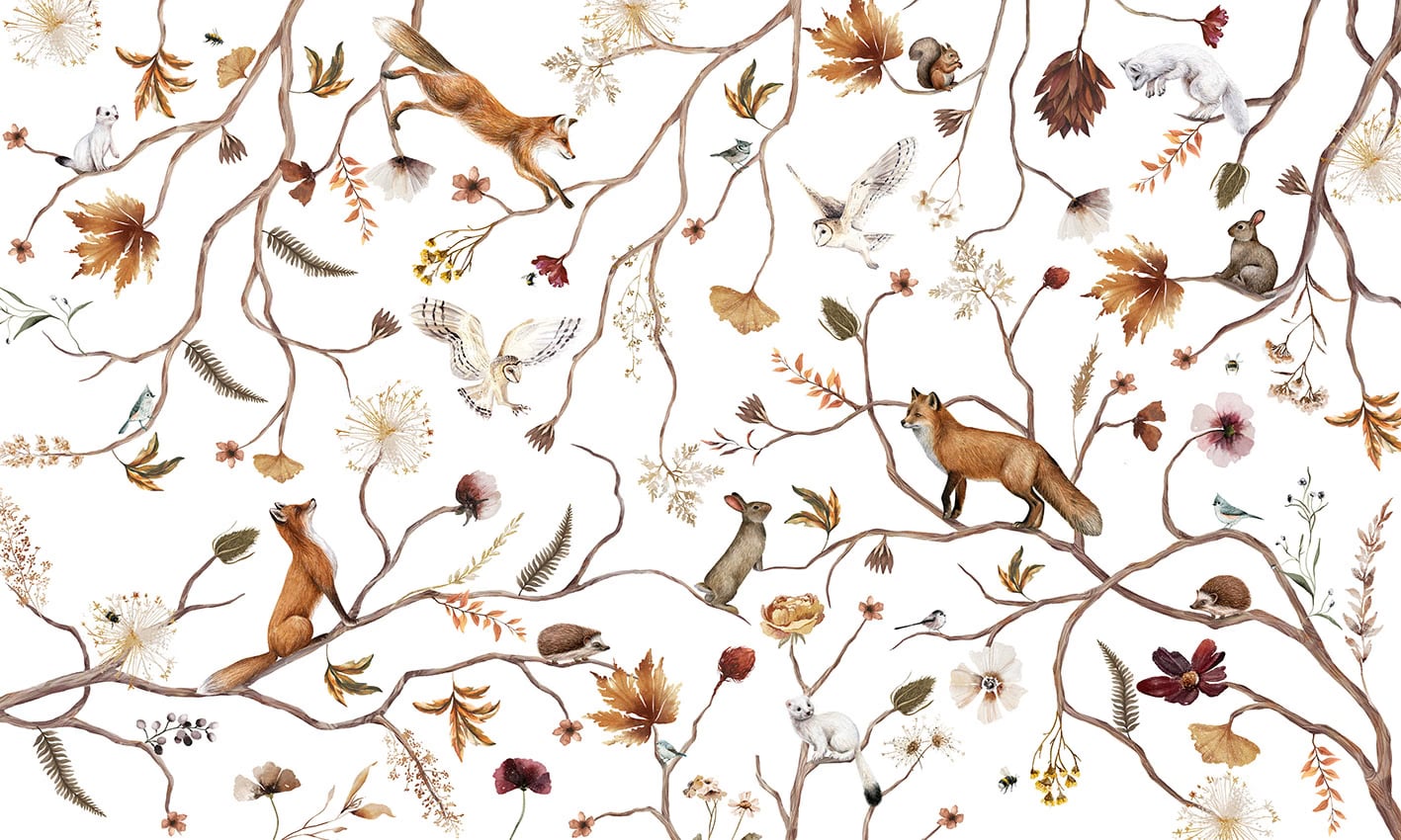
Playful Forest — foxes and autumn leaves on fine winding branches, on white. Light enough for a small room and for the wall that catches the afternoon sun.
Secret Sealife — a turquoise sea with a whale, a seal and an octopus. Cool and soothing, with plenty of gentle things to find. Good behind a bed.
Monochrome Forest, Blue Vintage — a whole forest printed in one soft, misty tone. The restful choice when a child already has a lot going on in the room.
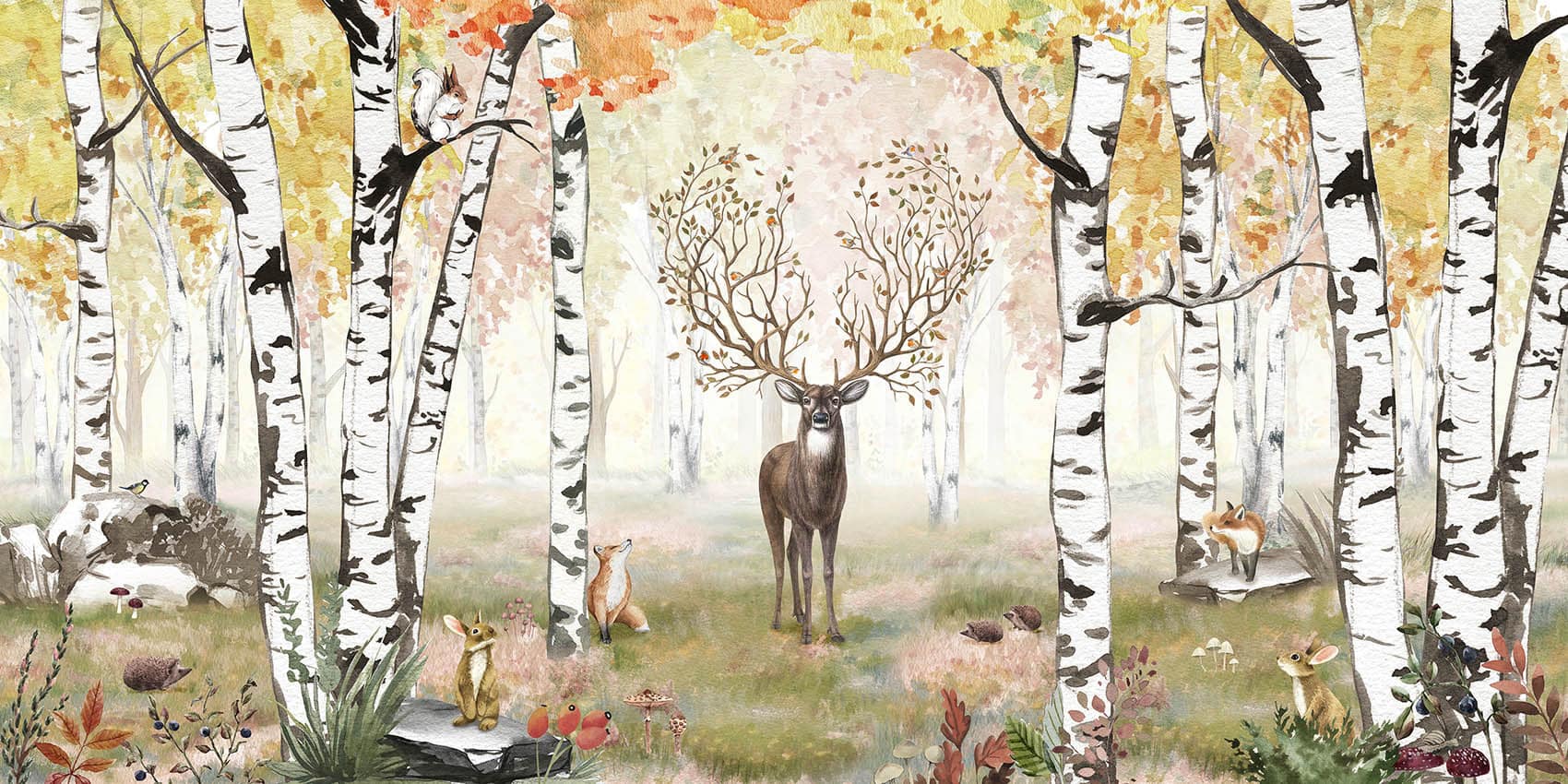
Amazing Antlers, Autumn — a stag among birch trees with golden leaves falling. Warm and a little magical, and it holds its colour on a bright wall.
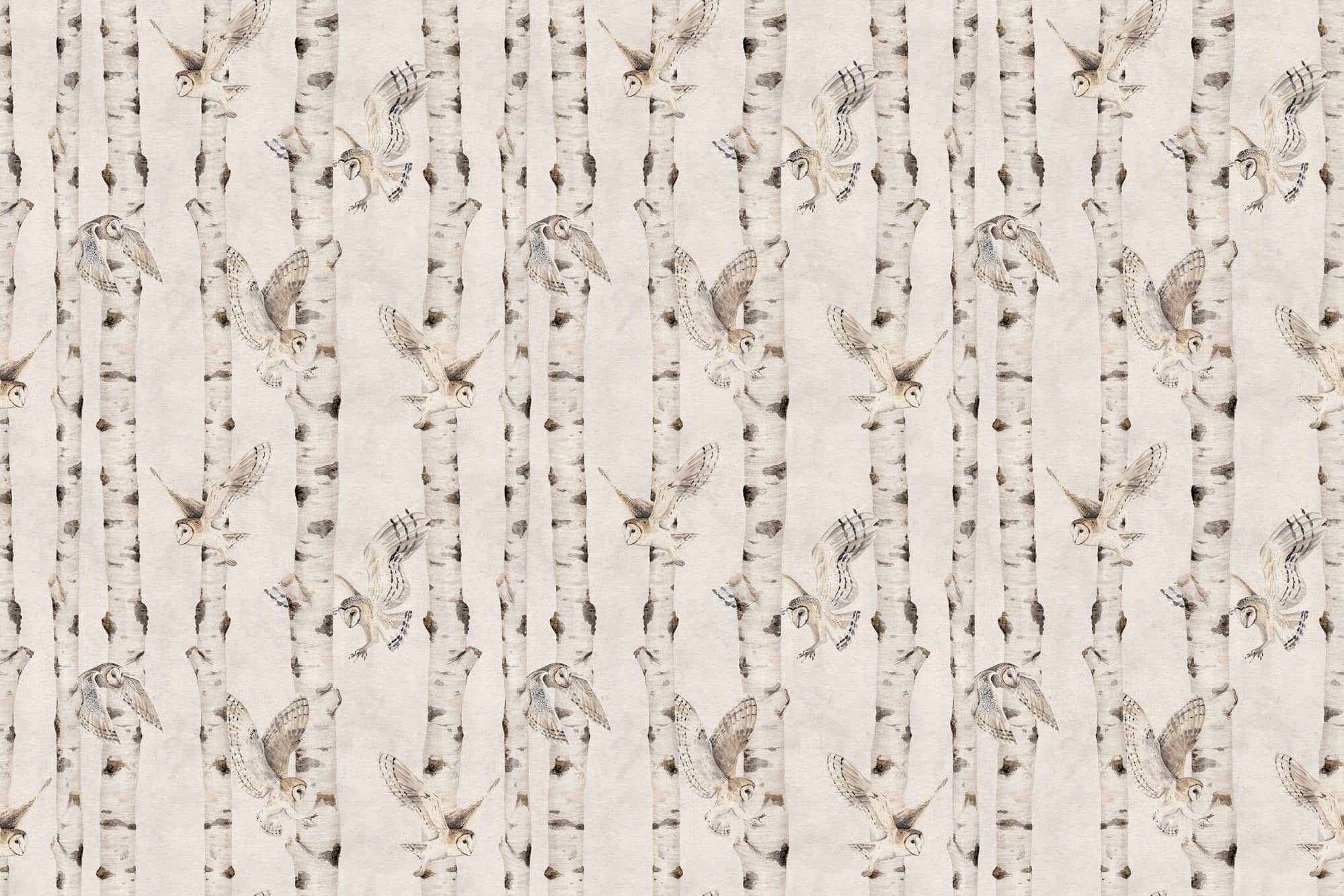
Birch and Owls, White — a true repeat, so it tiles across any width. The one to pick for all four walls.
Canopy Jungle — palms and bright parrots against a light sky. Full and fresh, and it turns a wall into a window on the treetops.
Fantastic Forest, Beige — a storybook forest of deer and toadstools on warm beige. Quiet enough to grow into.
Dreamy Daisies — fine daisies and meadow stems in a delicate spray. Barely a pattern at all, which is rather the point.
Measuring is the bit people worry about, and shouldn't
You need two numbers: the width of the wall and its height, corner to corner and floor to ceiling. Measure in three places for each and use the largest, because very few walls are truly square.
We print to those measurements rather than to fixed panel sizes, so the pattern lands where you want it. Our measuring guide walks through it with pictures, and if you would rather not, send us the photos and we will do it.
Start with the wall, not the catalogue
Pick the wall first. Note where the light falls and where the bed goes. Then choose the design that suits that wall, and the material that suits the room.
You can browse the full Kikki Belle range whenever you like, or see any design at your own dimensions in the room visualiser before you decide anything.


