Wallpaper mural vs paint feature wall: how to choose
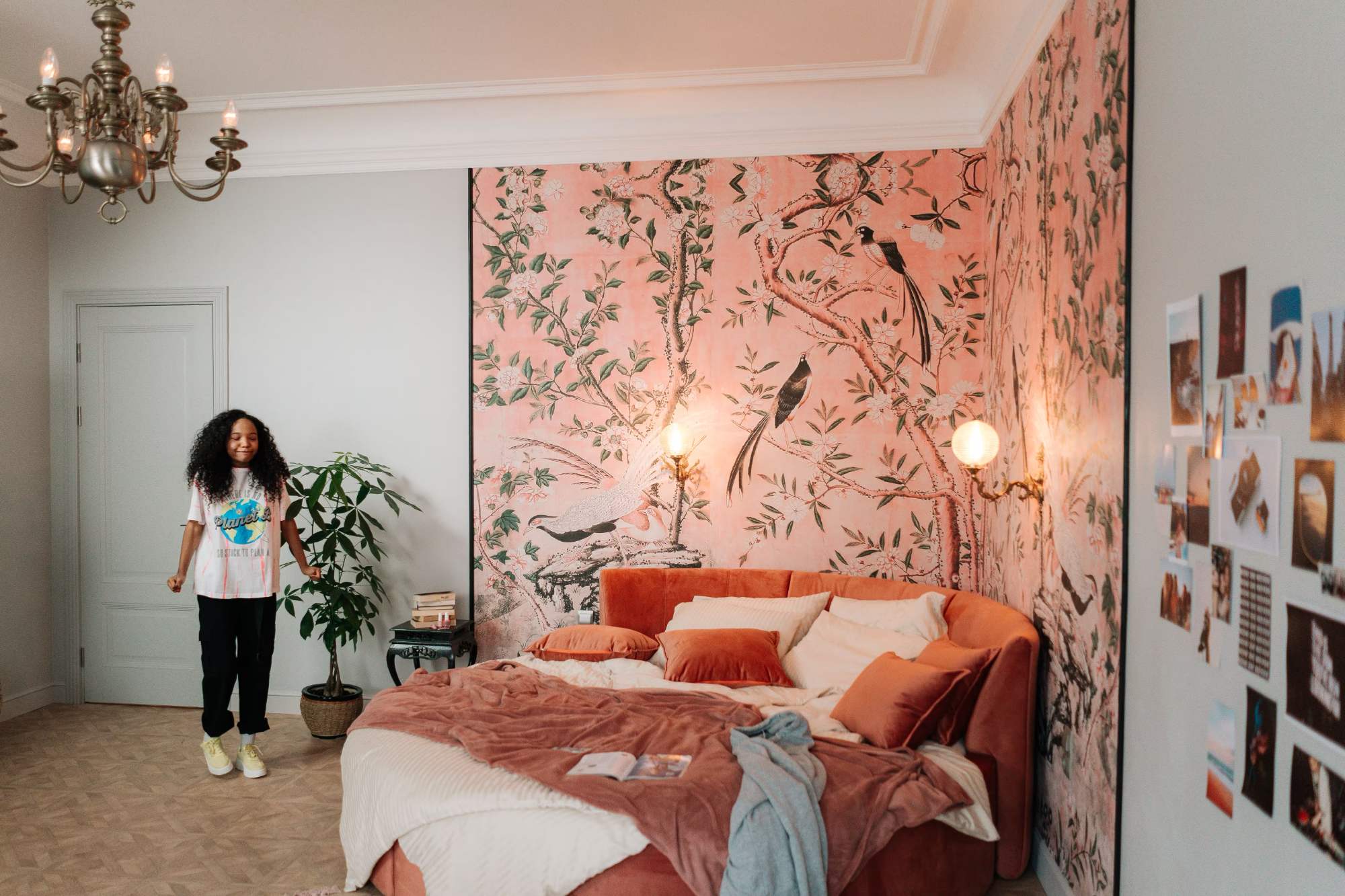
You have one wall and two ways to treat it. That, in a sentence, is the mural vs paint feature wall question — and it is a more interesting decision than it looks, because the two options are not really competing on the same thing. Paint gives you a colour. A mural gives you an image, printed to the exact size of that wall. Both can be lovely. Only one of them is easy to undo, and only one of them can put a forest behind your sofa.
So instead of declaring a winner, let's work out which one your wall is asking for.
What you are actually choosing between
A painted feature wall is a colour decision. One tone, edge to edge, in a finish you pick — and all the skill sits in choosing a colour that flatters the room's light rather than fighting it. It is a quiet, architectural move, and when it is right it is very right.
A mural is a picture decision. You choose a design, enter your wall width and height in centimetres, and the image is sized to that wall — not to a roll made in a factory that has never met your condo. We add the bleed and work out the panels before it goes to print, so the composition lands where it should.
That difference is the whole article, really. Paint changes the colour of a room. A mural changes what is in it.
Where paint genuinely wins
We would be poor company if we pretended otherwise. Paint is the better answer when:
- You like changing your mind. If you rearrange the flat every other year and enjoy it, paint is the medium that keeps up with you.
- The decorators are already in. If the whole place is being repainted anyway, one accent wall is a colour choice, not a project.
- The wall is chopped about. Two doors, a window and an aircon unit at an awkward height leave you with offcuts rather than a composition. An image needs a clean run to read as one thing; colour does not care.
- You want the wall to step back, not forward. Deep, quiet colour behind open shelving lets the objects be the event. A mural behind a busy shelf is a mural you have paid to hide.
One warning, though, because it catches people out. Colour behaves very differently at wall scale than it does on a card the size of a biscuit. A shade that looked sophisticated in the shop can read chalky across three metres in an afternoon's west light. Whichever way you go, judge it big.
Where a mural wins
It can do things paint cannot. Paint has no horizon. It cannot recede, or hold a mist, or grow a fern up past the picture rail. If what you want from the wall is depth — the sense that the room carries on a little further than it does — an image is the only thing that delivers it. Something like Mountain Forest, a pine forest rising toward snow-capped peaks, puts distance on a wall that has none.
It is made for your wall, not a standard one. This is the bit most comparisons skip, because they are quietly comparing paint with roll wallpaper. Roll patterns arrive at a fixed scale and your wall decides only where they get cut, which is why so many end in a half-motif in the corner. A made-to-measure mural has nothing to land badly — it was composed for this wall and no other. The full process is set out in how it works.
You can see it before you commit. With paint you buy a tester, live with a patch for a week and squint. With a mural you can put your own measurements into the room visualiser and see the design at true proportion in a photographed room. It settles arguments faster than a tester pot ever has.
It can be yours specifically. A photograph from a trip, a child's drawing, a piece of art you own — you can start with your own image and have it printed at wall scale. Paint, for all its virtues, has never done sentiment.
And it need not be a picture at all. If what drew you to a painted feature wall was colour rather than pattern, a design like Rotko Clay — bright turquoise above a band of burnt orange and deep teal — is still a colour decision. Just one that a single tin of emulsion cannot make.
The wall underneath decides more than the finish does
Here is the thing both options have in common, and it is the thing most people skip.
Thai homes and condos are usually concrete with a skim coat on top, which is a fine surface and an unforgiving one. Raking afternoon light across a flat painted wall will find every ripple and hairline crack the plasterer left behind, and matte paint in a strong colour is unforgiving about it. A printed design has pattern and tone moving across it, which is simply harder for a small imperfection to interrupt — and our Fabric Backed Wallpaper is specifically forgiving on walls that are not perfectly flat.
Damp, though, is not a finish problem. If a wall has a moisture issue, it needs fixing before you put anything on it — paint included. Covering it is not solving it, in any material.
If you rent, the question changes shape
Renters often assume paint is the safe option and a mural is the risky one. It is worth turning that over.
Repainting a wall means repainting it back at move-out, in the exact landlord white you will spend a Saturday trying to match. Meanwhile our Vinyl Wallpaper Sticker is peel-and-stick and fully removable, with no paste involved — it goes up on the wall you were given and comes off the same way. Your landlord need never know the wall had a more interesting year.
Questions people actually ask
Is a mural more expensive than painting one wall?
For materials alone, paint usually asks less of you up front. A mural is priced openly per square metre from the measurements you enter, with the live rate for each finish on the materials page — so you can see the number for your actual wall before anyone talks to you. And most people hang it themselves with numbered panels and a guide; there is an optional paid installation add-on at checkout in greater Bangkok if you would rather not.
Can I have both?
That is usually the best answer in a small home. One mural wall, then pull a colour out of the design and paint the other three walls in it. The mural gets something to be measured against, and the room reads as though someone planned it, because someone did.
Will a mural make a small room feel smaller?
Not if it is calm. A large, quiet image with distance in it opens a room; a small, busy, high-contrast one closes it. Judge the busyness, not the size — and try it at true scale before you decide.
Which wall should get it?
Almost always the one behind you when you sit down: behind the bed, or behind the sofa. It is usually the longest uninterrupted stretch you own, and a design you do not stare at directly stays a pleasure for far longer than one you do.
What if I want botanicals rather than a picture?
Then you are on the most popular road of all. Something like Canopy Jungle, taken floor to ceiling, is what most people mean when they say they want a feature wall — they simply had not realised the alternative to green paint was a green canopy.
So: paint if the wall wants to step back, a mural if it wants to say something. Neither answer is wrong, but only one of them is worth measuring for.
If it is the second, measure the wall, choose your size, and see the design on it before you spend anything. The wall has been beige long enough to wait five more minutes.