Print your own photo as wallpaper: an honest Bangkok guide
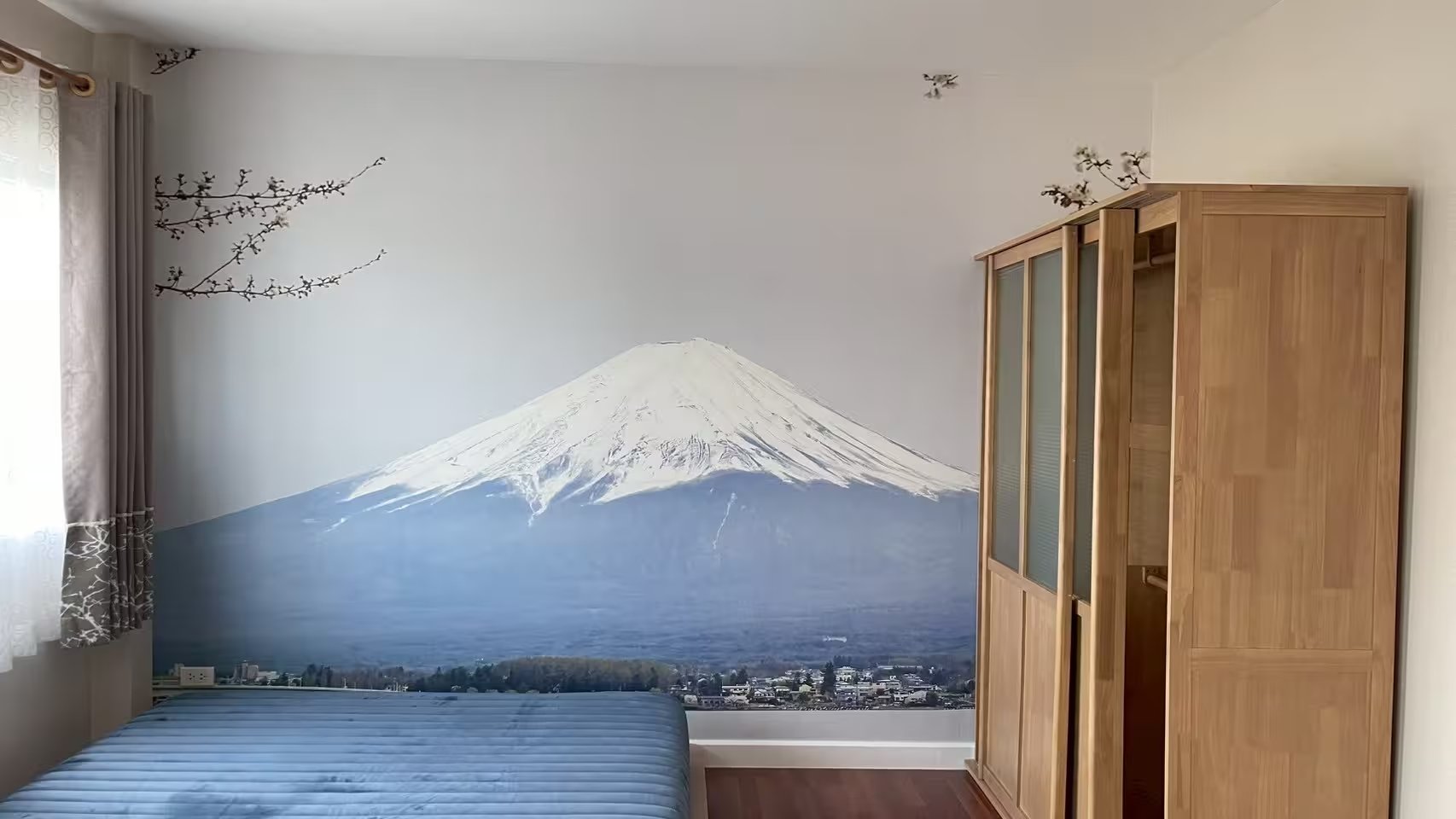
There is a version of a mural that no catalogue can sell you: the photograph you took on a trip you keep talking about, a painting a grandparent made, a child's drawing that deserves to be bigger than a sheet of A4. Printing your own photo as wallpaper is the most personal thing we do in Bangkok, and it is also the job where honest expectations matter most — because a file that looks flawless on a phone can fall apart across three metres of wall.
So this is what actually happens when you send us your own image: what the page accepts, how we judge whether a file will hold up at wall size, what we need you to be sure of about rights, and which walls are worth doing this on at all. You can follow along on your design, which is where the whole thing starts.
What the upload page accepts
JPG, PNG or WebP. If the picture came off an iPhone it is very likely HEIC, which browsers cannot open — in Photos, use Share and choose a JPEG copy, or set Settings › Camera › Formats to Most Compatible before you shoot. Scans and camera exports are usually JPEG or PNG already.
One thing worth knowing, because it surprises people: at this stage your original file never leaves your device. The browser makes a reduced-size copy and only that copy is uploaded, which is why the page stays quick even on hotel wifi and why a large export is not a problem. That preview is stored privately, it is never shown publicly, and it is deleted if you decide not to go ahead. The full-resolution original comes later, and only once you have a price in front of you.
See it on a wall before you decide anything
Pick a room, type your wall width and height in centimetres, and your image is placed at the size it would really print. Not a thumbnail on a stock photo — true scale, so what you are looking at is the size it comes out.
This is the quickest way to find out whether a photograph survives being enlarged. A detail that carried a 15 cm print can turn into a smear at 300 cm. The reverse happens too, and more often than people expect: a soft, atmospheric image with very little detail in it — mist over water, a wash of colour, an out-of-focus foreground — frequently gains from the scale rather than losing to it.
The resolution rule, stated honestly
A mural is read from across a room, so it needs far less detail than a photo print you hold in your hand. The rule we use is about 76 DPI at final print size, which works out at roughly 30 pixels for every centimetre of wall width.
- A 2 m wide wall wants a file around 6,000 px across
- A 3 m wide wall wants around 9,000 px
- A 4 m wide wall wants around 12,000 px
That is the minimum — the point where it works. There is a second level we call sharp, at about 50 pixels per centimetre, where the image holds up even when you walk right up to it: 10,000 px on that 2 m wall, 15,000 px on the 3 m one. As you type your wall size, the page gives one of three verdicts on your file: too low resolution, acceptable and may soften up close, or sharp at this size.
Put those numbers against a real camera and the picture gets clearer. A recent phone shooting 12 megapixels gives you roughly 4,000 px across, which is comfortable up to about 1.3 m. A good mirrorless camera at 45 megapixels gives around 8,000 px, or about 2.6 m. That does not mean anything larger is impossible — "acceptable" is a genuine category, not a polite refusal, and a wall behind a sofa is never viewed from thirty centimetres away.
Two practical notes. If you are working from a painting or a drawing, scan it rather than photographing it, flat, at the highest resolution the scanner offers; a phone photo of a canvas carries the room's lighting and the lens's distortion along with it. And do not enlarge the file yourself before sending it. Upscaling adds pixels without adding information, and it takes away the one thing we can read honestly, which is what the original actually holds.
The part about copyright
The image has to be yours to print. Your own photograph, your own artwork, your child's drawing, a piece you commissioned and hold the rights to, or an image you have explicitly licensed for print at this size.
What it cannot be is a picture found on Pinterest, a film still, an album cover, another artist's work, or a stock photo you have not licensed for reproduction. We ask about this, and if the answer is uncertain we would much rather sort it out before anything goes on a press than afterwards. We are not lawyers and we will not pretend to be, but we will not print work that belongs to somebody else.
Which walls this is worth doing on
One wall, not four. A personal image works because it is a focal point, and it stops working the moment it becomes wallpaper in the ordinary sense. Behind a bed, along a stair, the backdrop of a home office, the wall a family looks at over breakfast — those are the ones.
The wall itself matters as much as the file. Existing wallpaper has to come off first, whatever finish you choose. A strongly textured surface will show through the print and will stop a self-adhesive material gripping properly. Humid rooms and rooms without air conditioning are better served by the paste-up finishes than the peel-and-stick ones, because condensation is what lifts self-adhesive edges over time.
Which finish suits your particular image is a real decision rather than a detail. A crisp photograph reads best on a smooth surface, where nothing scatters the fine detail; a painting or a drawing often gains from the weave of canvas, which gives brushwork somewhere to sit. Our materials page sets all eight side by side, and we will tell you which one we would use on your file when we reply.
One more thing that comes up on almost every enquiry: your image's proportions will rarely match your wall's. We can crop it, or extend the background out to the edges, and you should say which you would prefer in the note when you send it. It is much easier to agree that in advance than to discover it in a proof.
What happens after you send it
Custom artwork is quoted by hand rather than ordered online, which is deliberate — nobody should be able to check out with a file that will not print. We look at every image ourselves: the resolution, the crop, how it reads across a whole wall. You get a reply within one business day with a price and an honest read on the file.
Then we ask for the full-resolution original. You can send it by replying to our email, or with a transfer link such as WeTransfer or Google Drive, whichever is easier. Nothing is printed and nothing is charged until you have seen the quote and approved it. If you would like to see how the rest of it runs from there, how it works walks through printing, delivery and installation.
If you are sitting on a file and you are not sure it is good enough, send it anyway. The verdict costs nothing, and we would rather tell you the truth about a photograph than have you wonder about it for another year.